Nurur Rahim Noman
Update: 16:45, 3 July 2026
Labour Face Critical Test as Keir Starmer Departs
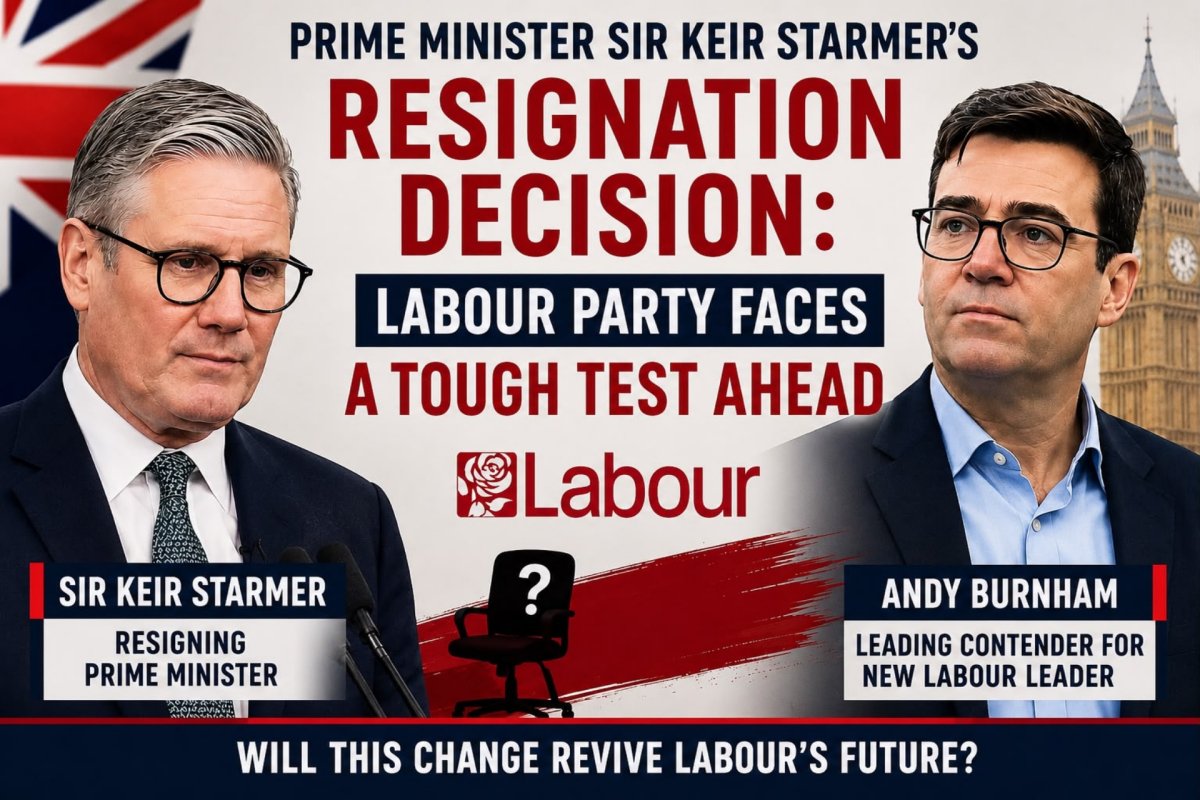
Picture: Eye News
Sir Keir Starmer— once a distinguished barrister widely known for his "Mr. Rules" image — ultimately failed to forge a meaningful connection with the British public as Prime Minister.
If Andy Burnham takes the helm, he will need to demonstrate swiftly that Labour is not simply changing its figurehead, but charting a genuinely new political course — one grounded in different priorities and backed by concrete action.
Two years ago, he swept to power in a landslide victory, yet he lacked any clear strategy for translating that mandate into effective governance and lasting political transformation. Political analysts suggest that he had assumed the business of governing would be relatively straightforward — a presumption that reality proved comprehensively wrong.
When Sir Keir announced his resignation, he was visibly emotional. Towards the end of his statement, in a deeply personal moment, he expressed heartfelt gratitude to his wife and two daughters — a rare and human side of a man more often associated with procedural rigidity.
A Question Long in the Making
For well over a year, a question had been quietly gathering force across Britain's political landscape: could Labour remain in power under Sir Keir's leadership, or would the party need to look for new direction? Running alongside that question was the recurring prospect of Andy Burnham — the popular Mayor of Manchester — returning to national politics. A significant portion of party activists, trade unions, and political commentators had long regarded him as Labour's most credible future leader. On 17 June, he confirmed his return to Westminster politics by winning a by-election.
Union Pressure for Real Change
Amid growing disillusionment with Sir Keir's leadership, criticism of economic policy, and mounting public anxiety over the cost of living, Labour-aligned trade unions had been sounding the alarm for some time. Their message was consistent: a change of leader alone is not enough — what is needed is substantive policy reform and its practical implementation.
Steve Wright, General Secretary of the Fire Brigades Union (FBU), delivered a blunt message to any incoming leadership. In his view, restoring public trust is impossible while maintaining the status quo.
Wright argued that successive governments over recent decades — regardless of political stripe — had failed to invest adequately in public services. The result has been widening economic inequality, the steady erosion of local services, and a landscape in which private utility companies have been free to extract enormous profits while ordinary people bear the financial burden.
From Margaret Thatcher to Boris Johnson, Liz Truss, and Rishi Sunak, Wright contended, all have operated within the same broad policy framework — and Sir Keir Starmer was no exception. His message to any new leader was clear: if genuine change is the goal, investment in the fire service and other public sector institutions, along with a fundamental restructuring of state service provision, must become the highest priority.
No Time to Waste
Sharon Graham, General Secretary of Unite — Labour's largest union affiliate — issued an even more direct warning. In her view, the window of opportunity for new leadership is narrow. Ordinary people have been carrying the burden of a cost-of-living crisis, soaring energy bills, and a stagnant economy for far too long.
Symbolic gestures will not suffice. What the moment demands is tangible, meaningful action.
Graham called for an immediate review of the energy price cap to ease financial pressure on consumers, and urged action to address the phenomenon of "fiscal drag," by which working people have been pulled into higher tax bands without a genuine rise in living standards. She warned that British industry and employment are in deep trouble, and that without large-scale, rapid investment in manufacturing, infrastructure, and job creation, a Labour government risks stumbling into a serious political and economic crisis.
Lessons from Starmer's Failure
Sir Keir Starmer entered Downing Street with a commanding parliamentary majority. Yet, as analysts have noted, he failed to convert that historic mandate into lasting political achievement.
Critics argue that his leadership never produced a coherent long-term economic and political framework. Too often, the government was consumed by managing immediate crises while failing to present the public with any credible vision of lasting change.
Internal party divisions deepened in parallel. Despite his substantial majority, Sir Keir repeatedly struggled to hold his own backbench MPs in line on key policy matters — and it was ultimately this erosion of internal support that undermined his authority, called his leadership into question, and left the government's strategic direction mired in uncertainty.
The Reality Awaiting Andy Burnham
Should Andy Burnham assume the Labour leadership, he will inherit both an enormous opportunity and a formidable test of political character.
As a symbol of renewal, he will carry the weight of immense public expectation — while simultaneously confronting a catalogue of crises left by his predecessor. Sluggish economic growth, a rising cost of living, instability in the energy sector, a fragile public services framework, and pressures on the labour market will all demand his attention from day one.
Most critically, neither the public nor the unions are in any mood for further promises. They want results. The traditional political "honeymoon period" for new leadership is unlikely to last long.
The Road Ahead
This is, without question, a moment of acute sensitivity and risk for the Labour Party. Sir Keir Starmer's departure closes one chapter — but in doing so, opens a considerably more complex one.
The trade unions' warnings are not merely institutional demands; they reflect the growing frustration and disillusionment of working people and the middle classes across the country.
If Andy Burnham takes the helm, he will need to demonstrate swiftly that Labour is not simply changing its figurehead, but charting a genuinely new political course — one grounded in different priorities and backed by concrete action.
Fail to do so, and the same public disaffection that paved the way for Starmer's fall could drive a new leader into crisis within a remarkably short time — and with it, the very real prospect of a severe Labour defeat at the next general election.
The leadership transition now underway is not merely the story of one individual's rise or fall. It is a defining test of Labour's future political philosophy, its capacity to rebuild public trust, and its ability to remain a credible force in government. The months ahead will make clear whether this is change in name only — or the genuine beginning of a new political era.
Nurur Rahim Noman, political analyst





- Tortoise: A Fascinating Creature of Patience and Longevity
- How Are You Meaning in Bangla – A Simple Guide
- The value of `Mohanagar` stretches far beyond social media hype
- What is Amazon Digital?
- Where is the Super Bowl 2025? Your Ultimate Guide
- The Mournful Day
- How to Become a Blogger: Your Complete Guide
- When is Memorial Day 2024 USA?
- How to Become a Dermatologist: Your Complete Guide
- What is a Verb? A Deep Dive into the Heart of Language