
Sangram Datta
Satgaon & the Sri Basudeb Temple
A Forgotten Legacy of Nearly Five Centuries
Satgaon & the Sri Basudeb Temple
Among the ancient settlements of greater Srimangal, Saptagram—historically known as Satgaon—stands as a site of singular historical significance. Surrounded by forests, low hills, and wetlands, this once-prosperous locality served for centuries as an important center of political authority, social life, and cultural exchange. The area is situated under Sreemangal Police Station of the former South Srihatta Sub-Division, now within Moulvibazar District, Bangladesh.
The history of Saptagram is inseparably linked with the celebrated medieval physician Chakrapani Datta and his illustrious lineage, the Datta family, whose influence shaped the region for generations.
Chakrapani Datta, the renowned author of the classical Ayurvedic treatise Chakradatta, rose to prominence in the 13th century when Gour Govinda, the ruler of Sylhet, was afflicted with a grave and seemingly incurable abdominal illness. At the earnest appeal of the queen, Chakrapani Datta arrived in Sylhet and successfully treated the king, restoring him to health.
In 1284 CE, the aged physician returned to Sylhet accompanied by his three sons—Umapati, Mahipati, and Mukunda. Reluctant to settle permanently in a land distant from the sacred Ganges, Chakrapani Datta eventually returned to his homeland, leaving behind his sons Mahipati and Mukunda, who chose to remain.
King Gour Govinda granted Mahipati the territory of Dakshin Shur and Mukunda the region known as Goya. Dakshin Shur was an extensive tract of land, bounded by the Barak River to the north, hills to the east, west, and south, and the Tripura kingdom to the south. Mahipati established his residence on the western edge of Hail Haor and named the settlement Saptagram, commemorating his ancestral homeland. The present-day village of Saptagram thus stands as a surviving descendant of the ancient Dakshin Shur.
During the rule of Kalyan Datta, a successor of Mahipati, Saptagram came under the control of the Tripura kingdom. Although Kalyan Datta continued as a feudatory ruler, the family endured prolonged political conflict and power struggles. Several villages founded in the names of his sons still exist today, serving as living historical markers of that turbulent era. A particularly influential figure of the Datta lineage was Sribatsa Datta, who actively supported Nawab Hussain Shah of Gour during his military campaign against Tripura.
Following Tripura’s defeat, the Nawab rewarded Sribatsa Datta with control over the parganas of Bhanugachh, Chhaychhiri, Ita, Pachaun, and Putijuri, and conferred upon him the honorary title “Datta Khan.” His elder brother, Bhaba Datta, was popularly known as “Baro Datta Khan.”
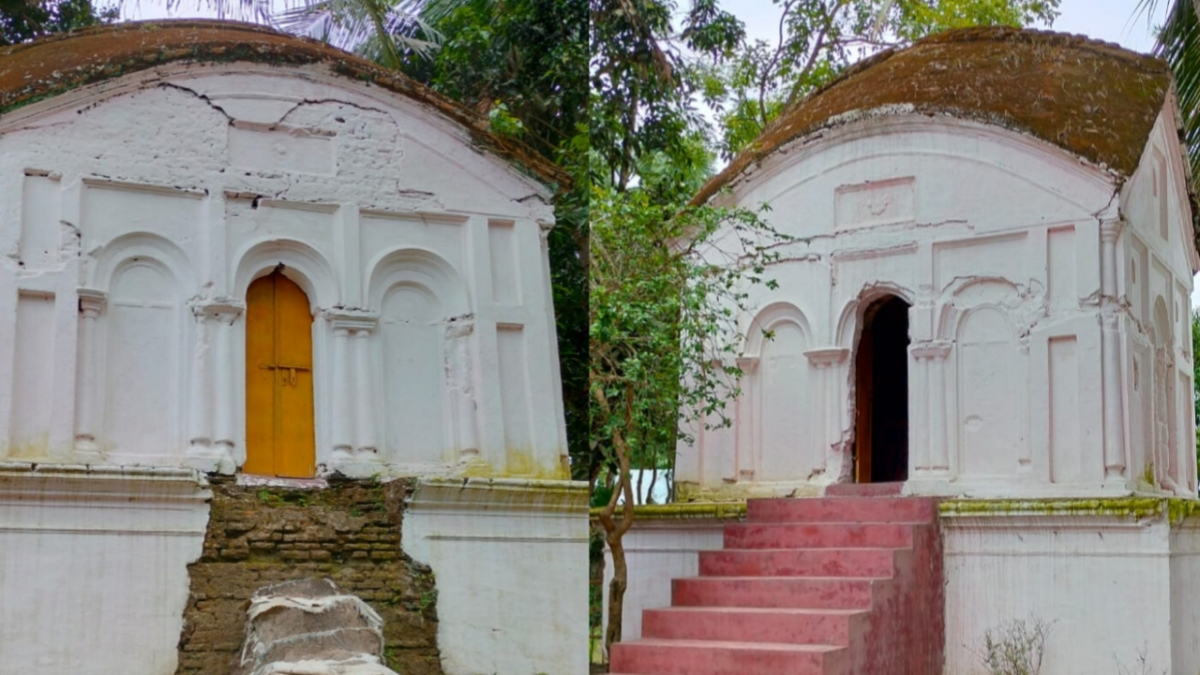
A new chapter in Saptagram’s history began with Haridas Datta, son of Sribatsa Datta. Historical sources indicate that Haridas Datta founded the village of Bhunabir, located in present-day Bhunabir Union of Srimangal Upazila. Adjacent to his residence, he constructed the Sri Basudeb Temple, an edifice built in a Buddhist architectural style, reflecting the syncretic cultural influences of the period. Though the original idol of Lord Basudeb was stolen long ago, the temple structure itself has survived for nearly five centuries, standing as one of the oldest surviving religious monuments in the region.
Haridas Datta’s successor, Kali Kumar Datta Chowdhury, later established the Bhunabir zamindar estate. While the estate’s former grandeur has largely faded with time, the ancient Sri Basudeb Temple continues to bear silent testimony to the family’s historical prominence. In 1896, Kali Kumar Datta Chowdhury founded the Bhunabir M.E. School at his residence, aiming to promote English education among local children. The institution operated until 1915 and was later reorganized as Dasharath High School.
During the 1965 Indo-Pak war, most members of the Datta Chowdhury zamindar family left behind their vast properties and migrated to regions such as Kamalpur in Tripura, Supriyakandi in Sribhumi district ( Previously Karimganj) in Assam, and Kolkata in West Bengal. It is reported that much of their valuable abandoned land was later illegally occupied and recorded under other names through corrupt practices involving certain land officials.
Among the last generation of the zamindar family, Bhuban Datta Chowdhury passed away in Bangladesh, while Pramod Datta Chowdhury (Rabi) died in Silchar, India, during the 1990s. Many descendants of the family subsequently migrated abroad.
Other known members of the lineage include Bishwajit Datta Chowdhury (Tutu) and his children, currently residing in Kamalpur, Tripura; Dip Datta Chowdhury and Bobby Datta Chowdhury, sons of the late Swapan Datta Chowdhury; and the children of Birendra Kishore Datta Chowdhury of Suprakandi in Karimganj district, Assam, who are now settled in Guwahati.
One notable descendant, Indira Datta Chowdhury, passed away on 21 November 2020 at the Purbaasha Residential Area of Srimangal. She was the wife of Rasendra Datta Chowdhury, a pioneering figure of left-wing politics in Srimangal and the greater Sylhet region, a veteran journalist, and an elected Chairman of the Srimangal Union Parishad during the 1980s. Rasendra Datta Chowdhury’s contributions to political movements, progressive journalism, and local governance remain a significant chapter in the region’s modern history.
However, no confirmed information is currently available regarding the present whereabouts of the descendants of Binod Bihari Datta Chowdhury and Mrityunjoy Datta Chowdhury. At present, the former zamindar residence is occupied by the family of a local resident, Sunil Deb. Notably, annual religious festivals and regular worship continue to be observed at the ancient Sri Basudeb Temple, ensuring the continuity of the area’s cultural and spiritual traditions.
Thus, Saptagram and the Sri Basudeb Temple represent far more than mere archaeological remnants or architectural relics. They embody a living legacy of nearly five centuries—one that persists despite neglect, limited institutional research, and insufficient preservation. The silent bricks of the temple and the enduring memory of the local people together affirm that Saptagram remains a dignified, if understated, presence on the historical map of Srimangal.
EN/SA








- Tortoise: A Fascinating Creature of Patience and Longevity
- How Are You Meaning in Bangla – A Simple Guide
- The value of `Mohanagar` stretches far beyond social media hype
- What is Amazon Digital?
- Where is the Super Bowl 2025? Your Ultimate Guide
- The Mournful Day
- How to Become a Blogger: Your Complete Guide
- When is Memorial Day 2024 USA?
- How to Become a Dermatologist: Your Complete Guide
- What is a Verb? A Deep Dive into the Heart of Language