Hasanat Kamal
Update: 20:18, 20 March 2026
How 3.9 Million Muslims Celebrate Eid in Britain — A Story Beyond
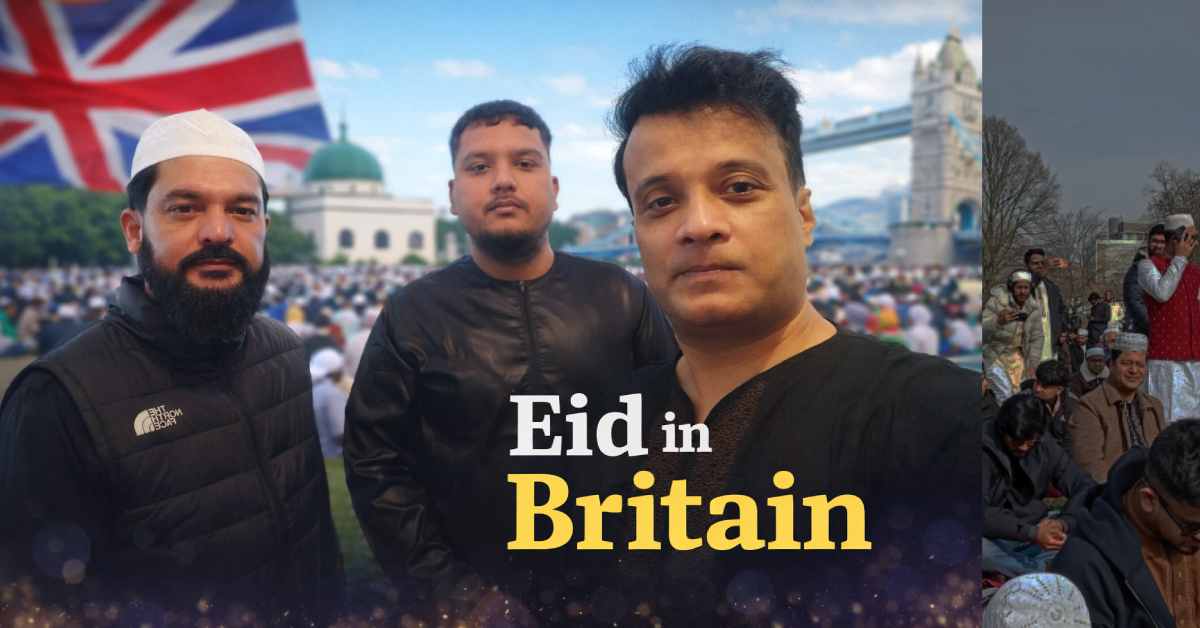
Eid in Britain Feels Different — A Personal Story from the UK Muslim Community
This year, I experienced Eid outside my home country for the first time. In Britain.
I had always been curious. How do migrants celebrate? Especially Bangladeshis. In a country shaped by people from every corner of the world, Eid felt like the perfect lens to understand that mix.
So I spoke to people. Young and old. I also looked through data and reports from organisations such as the Office for National Statistics, Muslim Council of Britain, East London Mosque, as well as archives, news reports and public datasets.
The numbers tell a clear story. Around 3.9 million Muslims now live in the UK. A significant portion are of Bangladeshi origin. Others come from the Middle East, Africa, the Caribbean, Pakistan and India.
A Personal Eid in Newcastle
I currently live in North Shields, near Newcastle upon Tyne, roughly 250 miles from London.
For Eid-ul-Fitr, we went to a small mosque in Whitley Bay, close to the sea. Simple. Clean. Quiet.
Most worshippers were from Bangladesh, particularly Sylhet. A few were Pakistani. Some from African and Caribbean backgrounds.
After prayers, people embraced. Smiles everywhere. Familiar faces, unfamiliar faces—it didn’t matter.
Back home, the usual spread followed. Semai. Polao. Meat. Bread. Friends dropped in. We visited others.
And yet, something felt missing.
Step outside, and there was little sign of Eid in this small town. No crowds. No visible festivity. No echo of the celebration you would expect back home.
London, however, tells a different story.
Eid in London: Scale and Energy
In London, Eid feels bigger. Louder. More present.
At East London Mosque, one of the largest congregations took place again this year. Around 10,000 worshippers attended prayers.
Nearby parks and community spaces were also filled. In East Ham Central Park alone, around 2,000 people gathered.
From Brick Lane to Newham, Miland Park, Stratford Park, Barking to Manor Park—Eid prayers were held across mosques and community centres.
But there is another reality too.
Many people left straight after prayers. Work calls. No public holiday. No pause.
For some, Eid ends almost as soon as it begins.
Food, Memory and a Sense of Home
Despite everything, traditions hold.
Homes are filled with food—pitha, sweets, semai, korma, polao. Conversations stretch long. So do memories.
There’s laughter. And a quiet kind of nostalgia.
Chaand Raat on Green Street
Green Street, Upton Park, and Whitechapel are well-known as Bengali-dominated areas of London. On Chaand Raat, these areas become incredibly crowded as the British Bengali community busily shops for Eid outfits. The atmosphere is so vibrant that it feels just like Zindabazar in Sylhet or Pashchim Bazar in Moulvibazar.
How Eid in Britain Evolved
It didn’t always look like this.
In the late 19th century, Muslims in Britain were few. In 1889, one of the first organised Eid prayers took place at the Shah Jahan Mosque in Woking. Only a handful attended.
Then came the early 20th century. Bengali sailors—known as lascars—arrived in port cities like London and Cardiff. They built small communities. Prayed in rented rooms.
Things shifted again after the 1970s.
Migration increased. Especially from Bangladesh. Communities expanded. Mosques multiplied. So did businesses and cultural spaces.
Eid followed that growth.
From Mosques to Open Parks
Space became an issue. Mosques were no longer enough.
So Eid moved outdoors.
Today, large parks across the UK host prayers attended by thousands. In Birmingham’s Small Heath Park, crowds have reached close to 100,000 in some years.
Eid is no longer hidden. It is out in the open.
One Festival, Many Cultures
British Muslims are not a single group.
They are Bangladeshi, Pakistani, Indian, African, Arab, Caribbean.
Eid reflects that mix.
Different clothes. Different food. Different accents. One shared moment.
More Than a Religious Event
Events like Eid in the Square at Trafalgar Square show how far things have come.
It’s not just a Muslim gathering anymore. People from all backgrounds attend. Music, food, performances—it feels like a city-wide celebration.
The Reality Behind the Celebration
Still, not everything is ideal.
Many don’t get time off work. Smaller towns lack large gatherings.
Yet people try. To keep traditions alive. To pass something on to the next generation.
What Eid Means in Britain
Eid here is more than prayer.
It is identity. Memory. Belonging.
A day where different cultures meet, briefly, on common ground.
What started quietly has grown into something much larger.
And it’s still evolving.
Sources and References:
1. The Shah Jahan Mosque Archive
2. The National Archives (UK)
3. The East London Mosque
4. BBC News
5. Greater London Authority
6. Muslim Council of Britain (MCB)
Read more: UK Reaffirms Stand Against Anti-Muslim Hatred at OSCE

- 73 Street in New York is now called `Bangladesh Street`
- Announcement of Ramadan office schedule of Bangladesh Embassy
- Bengali New Year is organized for the first time in Times Square
- Bangladeshi expats in UAE start getting NID cards from June
- Bangladeshi E-Passport service launched in Italy
- Bangladeshi-American promoted to captain in NYPD
- Saudi launched E-Visa for Bangladeshis
- London lights up for the first time to welcome holy Ramadan
- DU teacher Anik Paul missing in USA
- Qatar to enjoy an 11-day Eid Al Fitr holiday