Prottush Talukder, Environmental Special Correspondent
Update: 11:40, 13 April 2026
Bangladesh’s Vanishing Coastline: Climate Change, Salinity and the Struggle for Survival
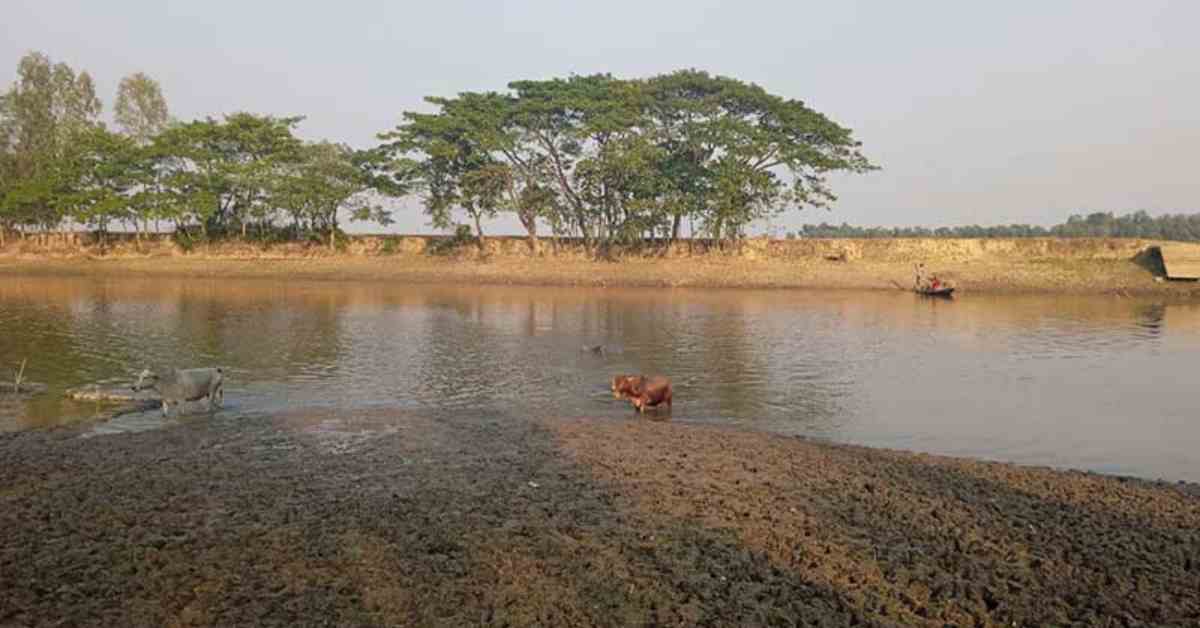
The shoreline in southwestern Bangladesh does not retreat all at once. It slips, quietly, almost without notice. A farmer in Satkhira pointed to where his rice field once stood. Now it is brackish water.
Sea-level rise is often discussed in abstract numbers. A few millimetres per year. But here, those increments accumulate into something harder to ignore. Crops fail. Drinking water turns saline. Families move.
Recent field visits suggest that salinity intrusion has begun reshaping livelihoods faster than local adaptation efforts can keep pace. Shrimp farming, once seen as a profitable alternative, has expanded into areas previously used for agriculture. It brings income, yes. But it also accelerates soil degradation and locks communities into a fragile, export-driven economy.
Government data indicates that millions of people in coastal districts are already exposed to rising salinity. Yet policy responses remain uneven. Large-scale embankment projects have helped in some areas, but they often fail under extreme weather. Cyclones, which appear to be intensifying, expose these structural limits.
There is also a governance gap. Local communities frequently report that they are not included in decision-making processes. Adaptation strategies are designed at the national level, while the impacts are deeply local.
Marine ecosystems are shifting too. Fishermen along the Bay of Bengal report declining fish diversity. Warmer waters and changing salinity levels appear to be altering migration patterns. Scientific monitoring remains limited, which makes it difficult to assess long-term trends with confidence.
What emerges is not a single crisis, but a layered one. Climate change interacts with economic pressures, weak infrastructure, and policy blind spots. The result is a slow erosion of both land and stability.
Bangladesh has often been described as a frontline state for climate impacts. That description may still hold, but it risks oversimplifying what is happening. This is not just exposure. It is transformation.
And it is already underway.








- Bangladesh Chhatra League full committee announced
- Takrim again first in the International Quran Competition
- A fire broke out in Bongo Bazar
- Enayetullah Abbasi may be banned in UK!
- Today is the birthday of the father of the nation
- Fire in Bongo Bazar: Mamun lost everything
- Sheikh Hasina will be elected for the fourth term : Bloomberg
- Bongo Bazar fire: 5 thousand traders are affected
- Consequences and Implications of Climate Change for the Haor Region
- Delwar Hossain Sayeedi passed away!