Rupom Acharjee
Update: 15:48, 12 August 2026
Fulvous-breasted Woodpecker, Nature’s Silent Craftsman
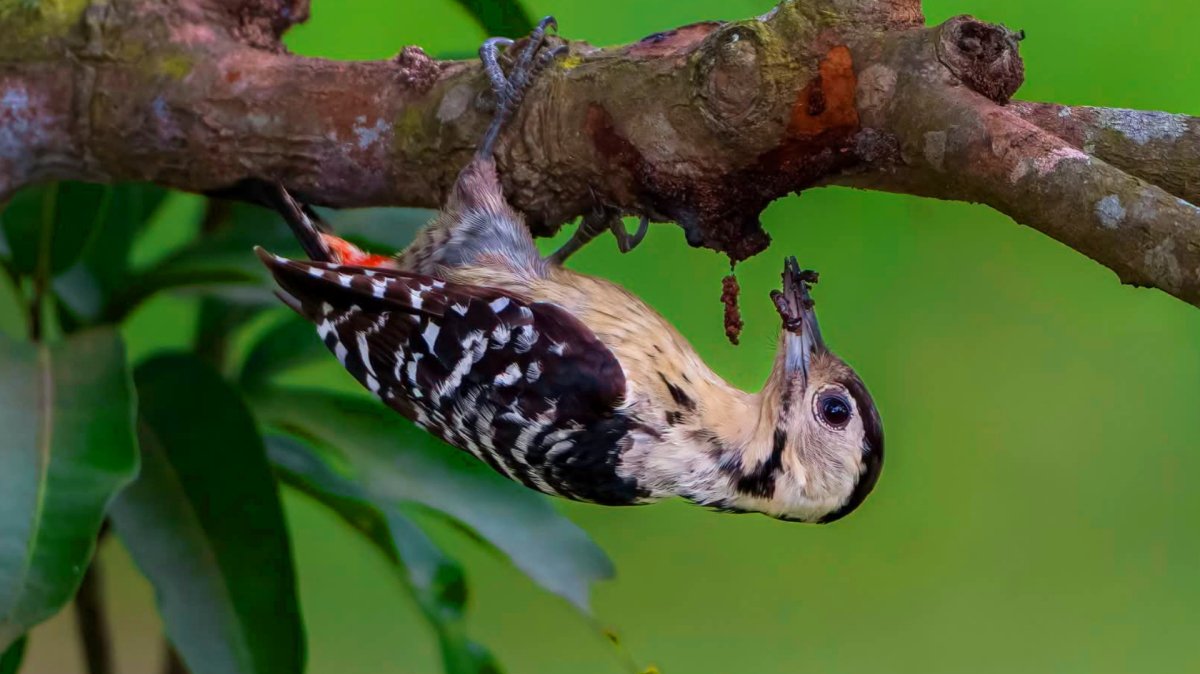
The photograph was taken by bird photographer and environmental activist Khukon Thounaujam.
In the silence of a green forest, a sudden tapping sound catches the ear. Looking toward its source, one may see a small bird repeatedly striking the trunk or branch of a tree with its beak. Sometimes it climbs upward along the trunk; at other times, it hangs upside down beneath a branch. This tireless activity is part of its search for insects hiding beneath the bark.
The bird captured in the photograph is the Fulvous-breasted Woodpecker, scientifically known as Dendrocopos macei. It is a medium-sized member of the woodpecker family, Picidae, and is distributed across Bangladesh and several other countries in South Asia.
Distinctive in Colour and Appearance
The upperparts of the Fulvous-breasted Woodpecker are predominantly black, marked with white spots and horizontal barring. Its breast and belly are yellowish-brown or fulvous, while the undertail has a reddish tinge. These characteristics are important for distinguishing the species from several other woodpeckers.
There is also a difference between males and females. In general, males have a red crown, while the crown of females is blackish. However, in field identification, birdwatchers do not rely on a single feature. The bird’s overall structure, plumage pattern and geographic range are considered together.
Its Beak Is Its Main Tool
The most distinctive feature of a woodpecker is its beak. Like other woodpeckers, the Fulvous-breasted Woodpecker searches for insects by tapping on tree bark and trunks. Its diet includes insects, insect larvae, ants, termites, grasshoppers, beetles and various other small creatures. It may also eat fruits and berries when available.
The bird searches for food on tree trunks, branches and around foliage. At times, it also comes down to the ground, particularly when searching for ants or termites. Thus, its feeding habits not only support its own survival but also help regulate insect populations within forest and tree-based ecosystems.
It Can Hang Upside Down with Ease
In Khukon Thounaujam’s photograph, the bird can be seen hanging beneath a branch with its head pointing downward. Woodpeckers have feet and strong claws specially adapted for gripping tree trunks and branches. This enables them to move vertically along tree surfaces and, when necessary, search for food on the underside of branches.
The moment captured in the photograph is therefore not merely aesthetically pleasing. It is also an excellent example of the bird’s natural adaptation and remarkable ability to forage for food.
The Tree Is Both Its Food Store and Its Home
The Fulvous-breasted Woodpecker is generally found in forests, open woodland, moist lowland forests, hill forests and other habitats rich in trees and vegetation. It has also been recorded in rural areas, gardens and around agricultural land near human settlements where mature trees are present.
Old and dead trees are particularly important in the lives of woodpeckers. The Fulvous-breasted Woodpecker can excavate holes in tree trunks or branches to build its nest. A study conducted at Jahangirnagar University in Bangladesh recorded this species among birds that nest in tree cavities and also documented competition with other birds for suitable nesting holes.
According to various sources, the breeding season generally extends from the early part of the year into spring. The bird lays several white eggs in a cavity, and both parents take part in incubation and caring for the chicks.
A Familiar Resident Bird of Bangladesh
The Fulvous-breasted Woodpecker is a well-established species in Bangladesh’s birdlife. In the country’s recent IUCN Red List, Dendrocopos macei is classified as Least Concern (LC). Globally, the species is also considered Least Concern.
However, being classified as “Least Concern” does not mean that its habitat is completely secure. The indiscriminate felling of old trees, the loss of forests and natural habitats, and excessive use of pesticides can have long-term impacts on the food sources and habitats of insect-eating birds.
Large, old and dead or decaying trees are especially important for woodpeckers. Such trees provide insects for food and often develop soft or hollow sections that are suitable for nesting. Therefore, protecting biodiversity requires not only conserving forests but also preserving naturally standing old trees.
A Small Worker in Nature
Many people may see the Fulvous-breasted Woodpecker as just another ordinary bird. But a closer look reveals that every tap of its beak against a tree trunk is part of a much larger natural process.
It searches for insects, creates cavities in trees, and those cavities may serve as its own nest and later become shelter for other birds. In this way, the presence of a single woodpecker can influence the relationship between a tree and many other species.
So, the rhythmic tapping of the Fulvous-breasted Woodpecker in the greenery is more than simply the sound of a bird calling or searching for food. It is also a sign that a living ecosystem is continuing its natural cycle.
The photograph captured by Khukon Thounaujam’s camera brings one moment of that largely unseen story into view. The little bird hanging upside down beneath a branch seems to remind us that the beauty of nature is often revealed most clearly through the natural behaviour of its inhabitants.
Photo: Khukon Thounaujam, bird photographer and environmental activist.






- How to Identify Fake Currency Notes in Bangladesh
- How to pick a good Mango
- What is the Difference Between a Coma and Brain Death?
- 10 Father`s Day Gift Ideas for Retired Dads
- Sea Level Rise in Bangladesh Faster Than Global Average
- 9 Common foods that don`t expire for years!
- Summer and sundresses!
- Gifts you can give to children on Eid
- Osmani Hospital launched pass card system for patient`s relatives
- Abnormal sleep patterns impact lung health