Rupom Acharjee
Century-Old Kachari Bari Faces Decay
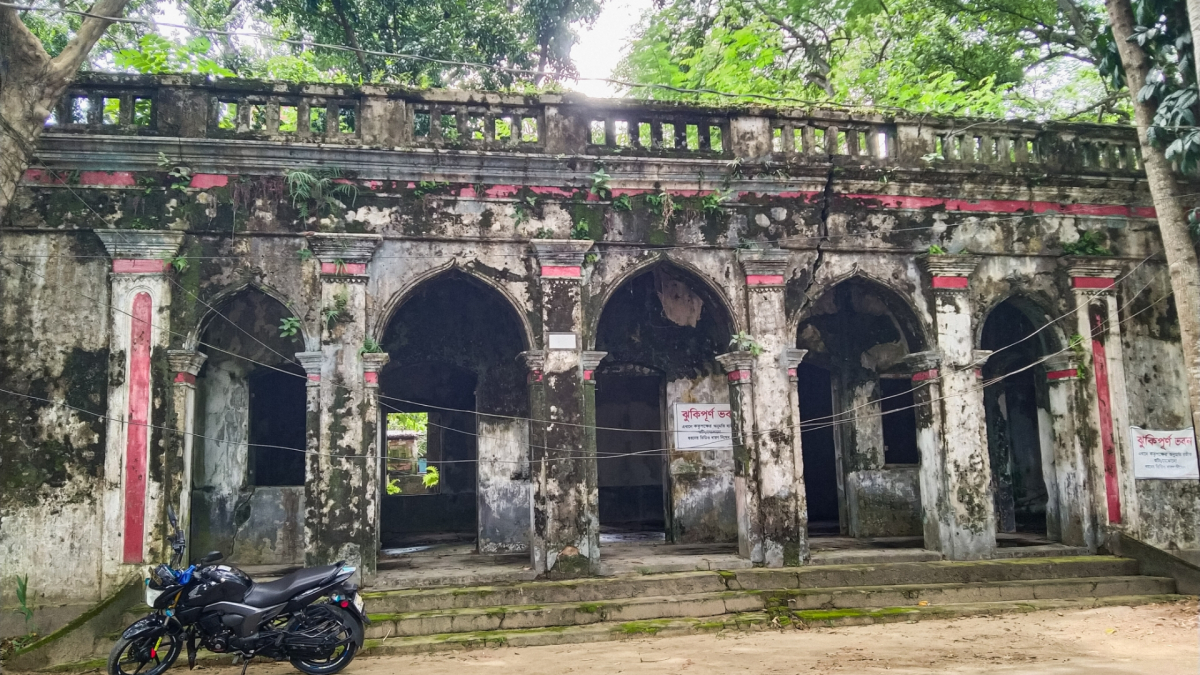
Kachari Bari of the Tripura Maharaja.
Along the busy Habiganj Road in the tourist town of Sreemangal, Moulvibazar, stands a historic structure that has witnessed more than a century of history. Weathered by time, covered in moss, and marked by deep cracks, the building is locally known as the Kachari Bari of the Tripura Maharaja. Once bustling with tenants, tax collection activities, and administrative affairs, it now stands in silence, bearing the weight of neglect and a fading past.
Every wall of the building reflects a chapter of a glorious history. Yet, due to the lack of proper preservation, this important heritage structure is gradually disappearing into the shadows of time.
An Administrative Center of the Tripura Kingdom
Historical sources indicate that following a devastating earthquake in the Dawki Fault region during the late nineteenth century, the Tripura royal family reorganized its administrative activities in the Sreemangal area. During the reign of Maharaja Bir Chandra Manikya Debbarma Bahadur, the architect of modern Tripura, the Kachari Bari was constructed primarily for tax collection and local administrative functions.
Later, during the reign of Maharaja Birendra Kishore Manikya Bahadur, the building evolved into a full-fledged administrative center. At the time, Sreemangal, Kamalganj, Bhanugachh, Shamshernagar, and surrounding areas were under the control of the Tripura royal family. Historical works such as Srihatter Itibritta by Achyut Charan Choudhury and Rajmala by Kailash Chandra Singh also document the influence and administrative reach of the Tripura Kingdom in this region.
Royal Heritage Reflected in Its Architecture
The architectural style of the Kachari Bari combines elements of British colonial design with local construction traditions. Arched verandas, thick lime-surki walls, decorative pillars, and elevated cornices give the structure a distinctive identity.
Research sources suggest that the building contains three rooms, eight doors, and nine windows. Walls nearly one foot thick demonstrate the durability and craftsmanship of the period. Today, large cracks are visible in various sections of the building, while parts of the roof have deteriorated and moss and vegetation have spread across its walls. Nevertheless, its arches and architectural details continue to showcase the elegance and royal character of a bygone era.
A New Identity After Partition
Following the Partition of 1947, the Kachari Bari came under the administration of the Government of Pakistan. It was later used for various land administration purposes. Although the building served as a government office for many years, preservation efforts remained limited compared to its historical significance.
A Valuable Historical Record at Risk
According to local researchers and heritage conservationists, the Kachari Bari is much more than an old building. It is an important testament to the historical relationship between Sreemangal, the greater Sylhet region, and the Tripura Kingdom. The structure serves as evidence that long before modern national boundaries were established, Sreemangal was closely connected to the administrative and economic activities of the larger Tripura state.
Despite its archaeological and historical importance, the building has yet to be included in Bangladesh’s officially protected heritage list. As a result, inadequate maintenance and restoration efforts continue to push it toward irreversible deterioration.
The Time for Preservation Is Now
Interest in heritage tourism and historical research is growing across Bangladesh. Known for its tea gardens, natural beauty, and the renowned Lawachara National Park, Sreemangal could also promote the Tripura Maharaja’s Kachari Bari as a significant heritage destination.
Achieving this would require government-led conservation initiatives, archaeological research, restoration projects, and greater public awareness. With proper preservation, the building could become not only a historical landmark but also an important center for education, research, and tourism.
A Legacy for Future Generations
The historic Kachari Bari of Sreemangal still stands today, carrying the memories of a remarkable past. This silent witness to history reminds us of a time when the building served as a center of administration and economic activity in the region.
The question remains: Will future generations be able to experience this living document of history, or will neglect and decay reduce it to nothing more than photographs and memories?





- How to Identify Fake Currency Notes in Bangladesh
- How to pick a good Mango
- What is the Difference Between a Coma and Brain Death?
- 10 Father`s Day Gift Ideas for Retired Dads
- Sea Level Rise in Bangladesh Faster Than Global Average
- 9 Common foods that don`t expire for years!
- Summer and sundresses!
- Gifts you can give to children on Eid
- Osmani Hospital launched pass card system for patient`s relatives
- Abnormal sleep patterns impact lung health