Hasanat Kamal
When Good Food Goes to Waste While People Go Hungry
A loaf of bread reaches a supermarket shelf after passing through a long chain of farmers, transport workers, processors and retailers. Yet every day, perfectly edible food ends up in bins while millions of people struggle to afford a decent meal. Few contradictions in modern society are as stark as this one.
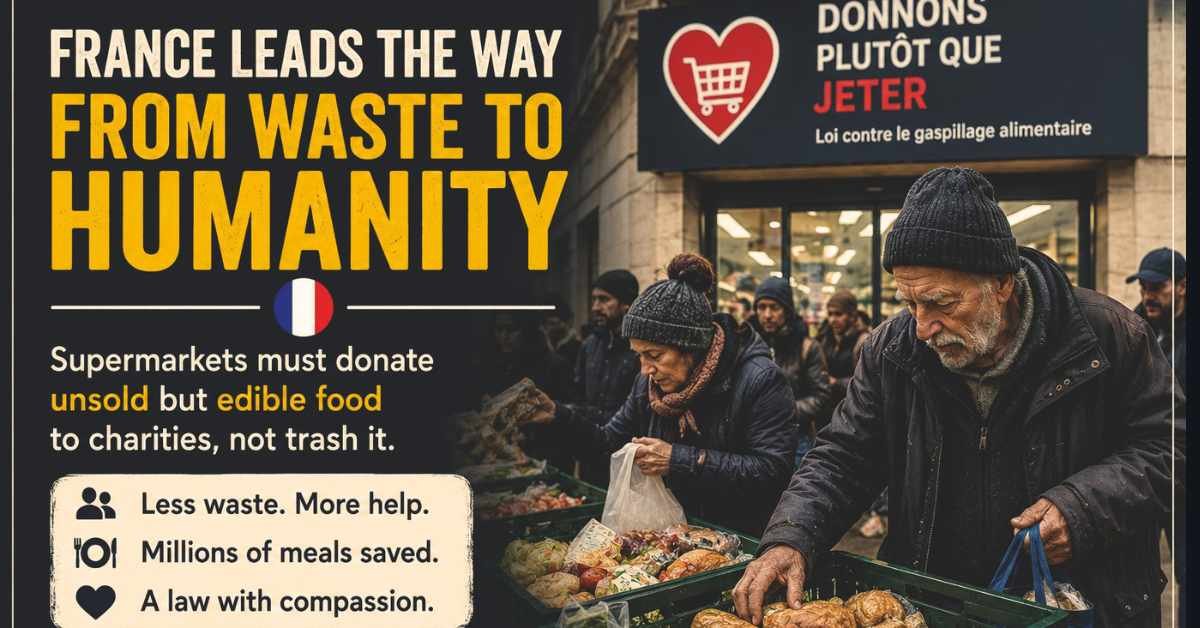
France has attempted to address that contradiction in a way that has attracted international attention. Since 2016, large supermarkets have been required to donate unsold but edible food to charities rather than destroy it. The policy was introduced after public concern grew over the practice of some retailers deliberately spoiling unsold food to prevent it from being collected by people in need.
The principle behind the law is simple. Food that is safe to eat should not be wasted when people are going hungry. It is a principle that resonates far beyond France.
Food waste is not merely an ethical issue. It is also an environmental and economic one. The resources used to produce food, including land, water, energy and labour, are effectively wasted when that food is thrown away. According to international estimates, roughly one-third of food produced globally is lost or wasted. At the same time, hundreds of millions of people experience food insecurity.
The contrast is particularly striking in wealthy countries. In the United Kingdom, restaurants, supermarkets and households discard large quantities of food every year. Anyone who spends time in cafés, hotels or restaurants will recognise the scene. Plates return to the kitchen with substantial portions untouched. Fresh food nearing its sell-by date is removed from shelves. Much of it ultimately enters the waste stream.
Of course, businesses cannot donate every item. Food safety standards must be respected. Storage, transportation and liability concerns are real. Yet France has demonstrated that practical systems can be established when governments, charities and businesses work together.
What makes the French approach noteworthy is not simply the redistribution of food. It is the recognition that food waste is a public concern rather than a private inconvenience. The law shifted the conversation from voluntary goodwill to social responsibility.
This raises an important question for other countries. Should edible surplus food be regarded as a resource that ought to be recovered wherever possible? There may not be a single solution suitable for every nation, but the principle deserves serious consideration.
In many communities, food banks and charitable organisations already perform remarkable work with limited resources. Stronger partnerships between retailers and charities could significantly expand their reach. Public awareness campaigns could also encourage consumers to waste less food at home.
Ultimately, the issue is about priorities. In a world where food production places increasing pressure on natural resources, reducing waste is no longer simply a matter of efficiency. It is a matter of fairness.
The image of edible food being discarded while families struggle to put meals on the table should make us uncomfortable. France's experience suggests that policy can help bridge that gap. The challenge for other countries is whether they are willing to do the same.
Food is too valuable to be treated as rubbish. And hunger is too serious to be ignored while perfectly good meals are thrown away.










- SSC Exam Result check 2026 Bangladesh
- NU Degree Result 2026 Bangladesh: Full Guide
- India Tourist Visa for Bangladeshis Resumes From May 6
- Eid al Fitr 2026 UAE Dates Confirmed and Expected Globally
- Cleaner Job Circular 2026 Saudi Arabia Latest Hiring Update
- Dubai-bound flight catches fire after taking off from Nepal
- Turkey`s homegrown 5th-generation fighter jet named KAAN
- Shihab Chottur reaches Makkah from India in 12 months
- Eid Ul Adha 2023 in Saudi Arabia!
- India gets new parliament building