
Hasnat Kamal
Venom Risk and Safety Facts
Banded Sea Krait Spotted on Bangladesh Coast
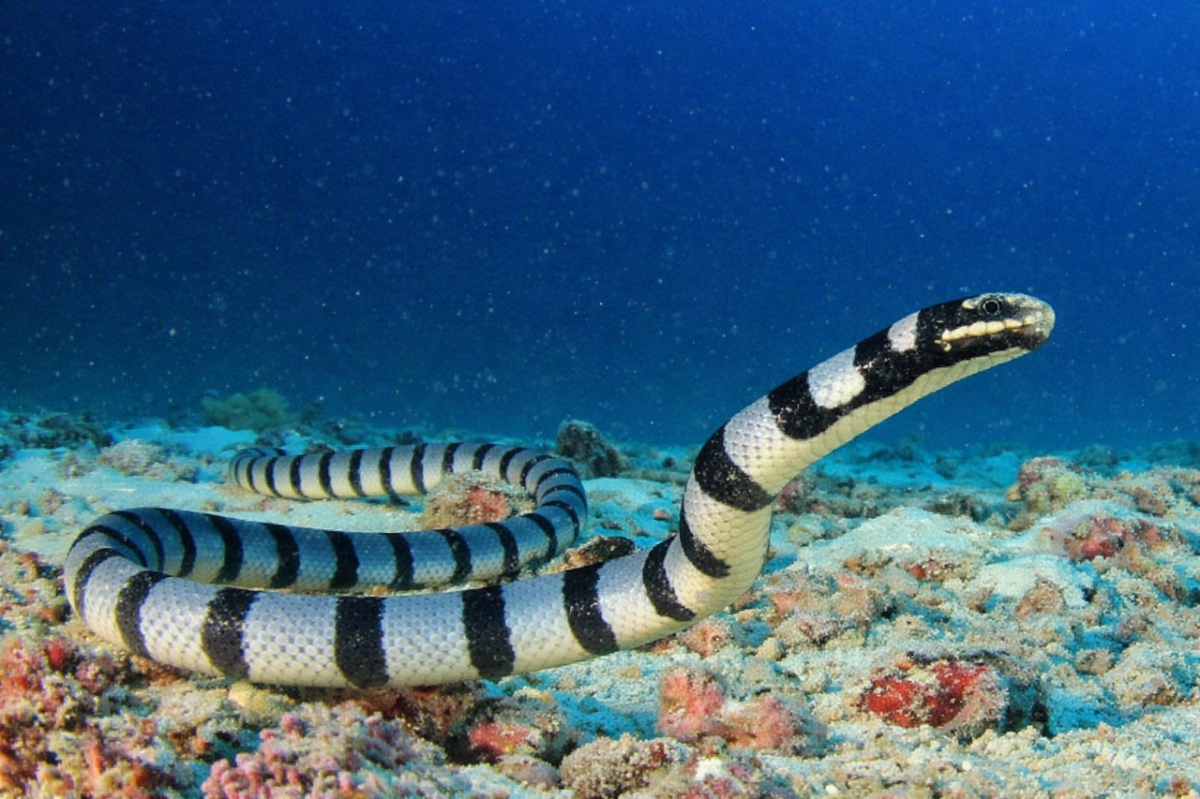
Banded Sea Krait
The Banded Sea Krait, a venomous marine snake scientifically known as Laticauda colubrina, has recently drawn attention after being caught in fishing nets along Bangladesh’s southern coastline. According to a report aired by DBC News, fishermen encountered the species near Shah Porir Dwip in the Kuakata region, highlighting growing interactions between humans and marine wildlife in the Bay of Bengal.
The Banded Sea Krait is widely distributed across the Indo Pacific region, including coastal waters of South and Southeast Asia. It is easily recognized by its distinctive black and white bands and its ability to move both in water and on land. Unlike fully aquatic sea snakes, this species often comes ashore to rest, digest food, or lay eggs, increasing the likelihood of encounters with people.
From a scientific perspective, the Banded Sea Krait is highly venomous. Its venom contains potent neurotoxins capable of affecting the nervous system and causing muscle paralysis. Despite this, experts emphasize that the snake is not aggressive. It rarely bites unless threatened, handled, or accidentally stepped on. Most recorded bites occur when fishermen attempt to untangle the snake from nets or mistake it for a non-venomous species.
Medical professionals warn that sea snake bites can be deceptive. Symptoms may take several hours to appear and can include muscle pain, weakness, breathing difficulties, and paralysis. Immediate medical attention is essential in any suspected bite, even if initial pain seems mild.
For coastal communities and visitors, awareness is the key to safety. Fishermen are advised to use protective gloves, avoid direct contact with unknown marine animals, and release snakes carefully using tools. Tourists and beachgoers should keep a safe distance from any striped snake found on shore and avoid attempts to photograph or touch it.
The presence of the Banded Sea Krait also reflects the ecological richness of Bangladesh’s coastal waters. As a predator, it plays an important role in maintaining marine balance by controlling populations of fish and eels. Conservationists stress that protecting such species is vital for the long-term health of marine ecosystems.
As climate change, overfishing, and habitat disruption continue to alter coastal environments, encounters with marine wildlife are expected to increase. Accurate information, public education, and respect for nature remain the most effective ways to reduce risk while preserving biodiversity.
EN/SA








- Bangladesh Chhatra League full committee announced
- Takrim again first in the International Quran Competition
- A fire broke out in Bongo Bazar
- Enayetullah Abbasi may be banned in UK!
- Today is the birthday of the father of the nation
- Fire in Bongo Bazar: Mamun lost everything
- Sheikh Hasina will be elected for the fourth term : Bloomberg
- Bongo Bazar fire: 5 thousand traders are affected
- Consequences and Implications of Climate Change for the Haor Region
- Delwar Hossain Sayeedi passed away!